
The word “divide” means to separate something into parts, groups, or sections. It can also describe sharing something among people, splitting responsibilities, separating opinions, or calculating numbers. Choosing the right alternative depends on what you want to express and how formal your writing needs to be.
Writers often look for synonyms for divide to avoid repetition, make instructions clearer, or choose more precise language. For example, split works well in everyday conversation, allocate fits the distribution of resources, and segregate describes separation into distinct groups, sometimes with negative social implications. Understanding these differences helps you communicate accurately in essays, business emails, reports, and daily conversations.
Quick Answer: What Are the Best Synonyms for Divide?
The best synonyms for divide include split, separate, partition, distribute, share, allocate, break up, subdivide, distinguish, and distribute among. Use split for general separation, partition for creating distinct sections, allocate for assigning resources, and distribute for giving items to different people or groups. The best choice depends on context.
Quick List — Useful Alternatives to Divide
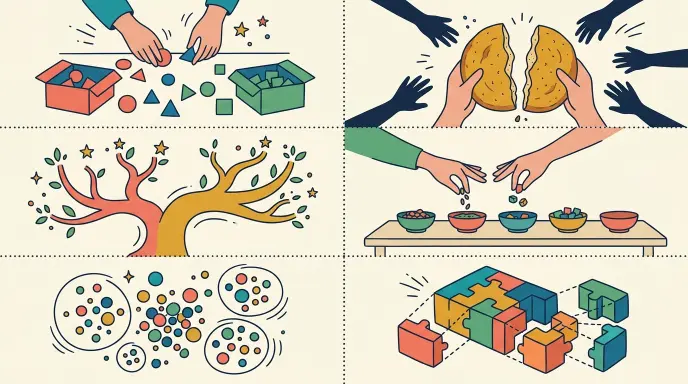
Here are useful alternatives grouped by meaning and tone.
Closest alternatives
- Split
- Separate
- Part
- Sever
- Partition
- Subdivide
- Break apart
- Break up
Formal alternatives
- Apportion
- Allocate
- Distribute
- Segregate
- Delineate
- Disaggregate
- Differentiate
- Demarcate
Neutral alternatives
- Share
- Distribute
- Group
- Classify
- Distinguish
- Disperse
- Dissect
- Section off
Informal alternatives
- Split up
- Break into pieces
- Cut in half
- Break apart
- Chop up
- Break down
Context-specific alternatives
- Assign — give duties or responsibilities to people
- Categorize — organize items into categories
- Disperse — spread people or things over an area
- Partition — separate an area into sections
- Apportion — divide something according to a plan or proportion
- Disagree — describe a difference in opinions, not a physical division
- Share out — distribute something among people
- Decentralize — spread authority or control across different locations or groups
Not every alternative is interchangeable with divide. Some describe physical separation, while others refer to mathematics, organization, distribution, or differences in opinion.
Formal Alternatives to Divide
Formal alternatives can make academic papers, professional reports, and official documents more precise. Choose the word that describes the exact action rather than simply replacing divide with a longer word.
1. Partition
Meaning: To separate something into distinct sections or parts.
Explanation: Partition is a close synonym when a whole is separated into clearly defined sections. It often appears in mathematics, computing, property planning, and technical writing.
Example: The research team partitioned the data into four groups.
Best Use: Technical reports, data analysis, room layouts, and formal descriptions.
Worst Use: Casual situations where split sounds more natural.
Tone: Formal and technical.
2. Apportion
Meaning: To distribute something according to a particular share, rule, or proportion.
Explanation: Apportion focuses on how much each person or group receives. It is not simply about separating something into pieces.
Example: The committee apportioned the budget among three departments.
Best Use: Budgets, costs, responsibilities, and resources.
Worst Use: Describing the physical separation of a broken object.
Tone: Formal and administrative.
3. Allocate
Meaning: To assign resources, time, money, or responsibilities for a particular purpose.
Explanation: Allocate emphasizes planned assignment rather than physical separation.
Example: The manager allocated two hours for employee training.
Best Use: Business plans, project management, budgets, and scheduling.
Worst Use: Describing someone cutting a piece of paper into smaller pieces.
Tone: Professional and precise.
4. Distribute
Meaning: To deliver or spread items among people, places, or groups.
Explanation: Distribute is appropriate when something is given or spread across several recipients or locations.
Example: The teacher distributed the worksheets among the students.
Best Use: Supplies, documents, products, information, and resources.
Worst Use: Describing a clear physical boundary without any spreading or delivery.
Tone: Neutral to formal.
5. Subdivide
Meaning: To divide something that is already a part into smaller sections.
Explanation: This word suggests an additional level of separation. A large section may be subdivided into smaller units.
Example: The architect subdivided the building into separate office spaces.
Best Use: Land planning, research categories, documents, and complex structures.
Worst Use: Simple situations where no smaller sections are being created.
Tone: Formal and technical.
6. Delineate
Meaning: To define or describe the boundaries of something clearly.
Explanation: Delineate often means to show where one area, responsibility, or concept ends and another begins. It does not always mean physically separating something.
Example: The policy delineates the duties of each department.
Best Use: Policies, academic writing, planning, and professional reports.
Worst Use: Giving someone half of a sandwich.
Tone: Formal and precise.
7. Segregate
Meaning: To separate people or things into different groups.
Explanation: Segregate can describe the separation of materials or categories. When applied to people, it can carry serious social and historical implications, especially when separation is imposed unfairly.
Example: The laboratory segregated recyclable materials from hazardous waste.
Best Use: Waste management, safety procedures, and specific discussions of social separation.
Worst Use: Describing an ordinary division of tasks when assign or separate is more accurate.
Tone: Formal, often sensitive in social contexts.
8. Disaggregate
Meaning: To break a combined set of information into smaller components.
Explanation: This term is particularly useful when analyzing data that has been collected or presented as a whole.
Example: The analyst disaggregated the survey results by age group.
Best Use: Statistics, research, analytics, and policy reports.
Worst Use: Everyday conversation about splitting a bill.
Tone: Technical and academic.
9. Demarcate
Meaning: To establish or mark a boundary between areas, groups, or responsibilities.
Explanation: Demarcate focuses on defining a dividing line rather than separating a physical object into pieces.
Example: The agreement demarcates the responsibilities of both teams.
Best Use: Legal documents, land descriptions, policies, and organizational planning.
Worst Use: Describing the act of sharing food.
Tone: Formal and authoritative.
10. Dissect
Meaning: To separate something into parts for close examination.
Explanation: Dissect can refer to physically cutting something apart or carefully analyzing an idea, argument, or text.
Example: The professor dissected the argument to identify its weaknesses.
Best Use: Scientific study, detailed analysis, and critical discussion.
Worst Use: Routine distribution of resources.
Tone: Analytical and precise.
Semi-Formal and Neutral Alternatives
These words work in school assignments, workplace conversations, general writing, and everyday explanations.
11. Split
Meaning: To separate something into two or more parts.
Explanation: Split is one of the closest and most versatile alternatives to divide. It can describe physical separation, costs, groups, and responsibilities.
Example: We split the project into three stages.
Best Use: General writing, teamwork, expenses, and instructions.
Worst Use: Highly technical contexts where a specific term such as partition is required.
Tone: Neutral and conversational.
12. Separate
Meaning: To move things apart or keep them distinct.
Explanation: Separate emphasizes the resulting distance or distinction between things. Unlike divide, it does not necessarily mean creating several parts from one whole.
Example: Please separate the completed forms from the unfinished ones.
Best Use: Sorting documents, organizing items, and explaining differences.
Worst Use: Assigning a specific share of money when allocate is more accurate.
Tone: Neutral.
13. Share
Meaning: To let several people use, receive, or enjoy something.
Explanation: Share emphasizes participation or joint use. It may involve dividing something equally, but equal distribution is not guaranteed.
Example: The siblings shared the cost of the repair.
Best Use: Expenses, resources, food, and responsibilities.
Worst Use: Situations where a strict separation or boundary is the main point.
Tone: Friendly and neutral.
14. Break up
Meaning: To separate a whole into smaller parts or groups.
Explanation: Break up is a natural alternative when organizing a large task, audience, or amount into manageable units.
Example: We broke up the assignment into smaller tasks.
Best Use: Planning, group activities, and everyday explanations.
Worst Use: Formal technical writing where subdivide may be more precise.
Tone: Conversational to neutral.
15. Group
Meaning: To put people or things together based on a shared feature.
Explanation: Group can be an alternative when dividing means organizing items into sets. However, it focuses on forming groups, not necessarily separating a whole evenly.
Example: The teacher grouped students by reading level.
Best Use: Classroom activities, data organization, and team assignments.
Worst Use: Describing a clean cut through a physical object.
Tone: Neutral.
16. Categorize
Meaning: To organize items according to their type or characteristics.
Explanation: Categorize works when dividing involves placing things into named categories rather than creating physical pieces.
Example: The website categorizes its articles by topic.
Best Use: Websites, libraries, research, and inventory systems.
Worst Use: Dividing money into exact shares without assigning categories.
Tone: Neutral to professional.
17. Classify
Meaning: To arrange people or things into classes based on shared features.
Explanation: Classify is similar to categorize, but it often suggests a more systematic or established classification method.
Example: Researchers classified the samples according to their chemical properties.
Best Use: Science, research, education, and records management.
Worst Use: Describing the physical act of cutting an object.
Tone: Neutral to formal.
18. Distinguish
Meaning: To recognize or show the difference between two or more things.
Explanation: Distinguish is useful when dividing ideas or concepts by their characteristics. It does not usually mean separating a physical whole.
Example: The essay distinguishes facts from personal opinions.
Best Use: Academic writing, comparisons, and explanations.
Worst Use: Sharing a limited budget among departments.
Tone: Neutral and analytical.
19. Disperse
Meaning: To spread people or things over a larger area.
Explanation: Disperse emphasizes spreading out rather than making distinct portions.
Example: The wind dispersed the seeds across the field.
Best Use: Describing crowds, particles, seeds, or resources spreading out.
Worst Use: Dividing a bill into equal payments.
Tone: Neutral to formal.
20. Part
Meaning: To separate or move apart.
Explanation: As a verb, part can describe people or objects moving away from each other. It is less common than split when dividing a quantity into shares.
Example: The curtain parted to reveal the stage.
Best Use: Describing movement, separation, or a gap opening.
Worst Use: Formal financial calculations.
Tone: Neutral, sometimes literary.
21. Section off
Meaning: To mark or separate an area into a distinct section.
Explanation: This phrase usually refers to physical spaces, such as a room, garden, or construction site.
Example: The organizers sectioned off an area for registration.
Best Use: Events, buildings, offices, and workspaces.
Worst Use: Dividing an argument into logical categories when organize or subdivide is clearer.
Tone: Practical and conversational.
22. Assign
Meaning: To give a task, role, or responsibility to a person or group.
Explanation: Assign is a contextual alternative when dividing work means deciding who will handle each part.
Example: The supervisor assigned each employee a specific task.
Best Use: Project management, schoolwork, and workplace duties.
Worst Use: Dividing a physical object into pieces.
Tone: Neutral and professional.
Informal and Casual Alternatives

Casual expressions can make everyday speech sound natural. They are especially useful in conversations, text messages, and informal instructions.
23. Split up
Meaning: To separate into smaller groups or parts.
Example: Let’s split up the chores so we can finish faster.
When It Sounds Natural: Conversations about tasks, teams, costs, or plans.
When to Avoid It: Formal reports or legal documents that need precise terminology.
Tone: Casual and direct.
24. Cut in half
Meaning: To divide something into two equal parts by cutting or reducing it by half.
Example: Cut the recipe in half because we only need two servings.
When It Sounds Natural: Cooking, physical cutting, and reducing quantities by 50%.
When to Avoid It: Dividing something into three or more parts, or when the shares are unequal.
Tone: Everyday and specific.
25. Chop up
Meaning: To cut something into smaller pieces.
Example: Chop up the vegetables before adding them to the soup.
When It Sounds Natural: Cooking and informal descriptions of cutting objects.
When to Avoid It: Professional discussions about dividing responsibilities or analyzing data.
Tone: Casual and practical.
26. Break into pieces
Meaning: To separate or cause something to separate into smaller parts.
Example: The glass broke into pieces when it hit the floor.
When It Sounds Natural: Describing damaged objects or explaining physical separation.
When to Avoid It: Formal descriptions of planned resource distribution.
Tone: Casual and descriptive.
27. Break down
Meaning: To separate something complex into smaller, easier-to-understand parts.
Example: Can you break down the instructions into simple steps?
When It Sounds Natural: Explaining complicated topics, tasks, or plans.
When to Avoid It: When you mean physically cutting something or distributing resources to recipients.
Tone: Conversational and helpful.
28. Share out
Meaning: To distribute something among several people.
Example: We shared out the snacks before the movie started.
When It Sounds Natural: Informal situations involving food, supplies, or small tasks.
When to Avoid It: Formal financial statements or official resource-allocation policies.
Tone: Friendly and informal.
True Synonyms vs. Contextual Alternatives
A synonym has a similar meaning to another word, but it does not always fit every sentence. Some alternatives preserve the basic meaning of divide, while others describe only one particular way of dividing.
| Type | What It Means | Can It Replace “Divide”? |
|---|---|---|
| True synonym | A word with a very similar meaning in a particular context | Often, if the sentence structure fits |
| Near synonym | A word with a closely related meaning | Sometimes; check the intended meaning |
| Contextual alternative | A word suitable for one specific situation | Only in that context |
| Broader expression | A phrase covering a wider idea | Sometimes, but details may be lost |
| Narrower expression | A word describing one specific type of division | Only when that specific meaning applies |
For example, split and divide are close synonyms in “We split the bill” and “We divided the bill.” Allocate is a contextual alternative when resources are assigned. Categorize works when items are sorted by type, while cut in half is narrower because it specifies two equal parts.
The safest approach is to check what happens to the sentence’s meaning after replacing the original word.
Industry-Specific Usage
Business Writing
In business writing, the best alternative depends on whether you are separating tasks, assigning resources, or organizing information.
- Allocate: “We allocated additional funds to customer support.”
- Distribute: “The company distributed the updated guidelines.”
- Assign: “The project lead assigned tasks to each team member.”
- Break down: “The report breaks down quarterly expenses.”
Use allocate for planned resources, assign for responsibilities, and break down when explaining complex information.
Corporate Communication
Reports, internal announcements, and company policies benefit from precise language.
- “The department will be subdivided into three units.”
- “The revised policy delineates each manager’s responsibilities.”
- “The presentation separates short-term goals from long-term priorities.”
Avoid replacing every instance of divide with a formal word. A straightforward sentence is often easier for employees to understand.
Academic Writing
Academic writing often requires words that describe a specific method of organizing information.
- Classify: The study classified responses according to topic.
- Disaggregate: The researchers disaggregated the data by region.
- Distinguish: The paper distinguishes correlation from causation.
- Subdivide: The chapter is subdivided into four sections.
Choose disaggregate for breaking combined data into smaller categories, not for every kind of separation. Use distinguish when comparing concepts rather than physically separating them.
Customer Service
Customer service messages should be polite, clear, and easy to follow.
- “We can split the payment into two installments, subject to the payment terms.”
- “I’ll separate the two orders so we can check each one.”
- “Let me break down the charges on your invoice.”
Avoid technical terms such as disaggregate unless they genuinely help explain the issue. Customers usually benefit from familiar words.
Legal Writing
Legal writing requires special care because terms may have specific meanings under a contract, statute, or legal procedure.
Words such as partition, sever, allocate, and apportion can describe different actions. Sever may refer to separating a legal provision or ending a connection, while partition may concern the division of property. Their meanings depend on the legal context.
For example:
“The agreement allocates responsibility for maintenance to the tenant.”
This sentence describes an assignment of responsibility. It does not necessarily mean that the property itself is physically divided.
Do not substitute a synonym in a contract or legal document without checking that it preserves the intended meaning.
Email Communication
For professional emails, use alternatives that make the action clear.
- Client email: “We can split the project into two phases.”
- Internal update: “I have separated the completed tasks from the outstanding items.”
- Request: “Could you allocate an additional hour for testing?”
- Follow-up: “I’ve broken down the outstanding costs in the attached summary.”
- Meeting: “Let’s divide the agenda into three discussion points.”
These expressions sound professional without making ordinary communication unnecessarily complicated.
Email Examples Using Alternatives to Divide
Here are six complete emails showing how different alternatives work in real situations.
Short Dialogue Examples
These short conversations show how alternatives to divide sound in everyday situations.
1. Workplace
Person A: How should we handle the new project?
Person B: Let’s split it into three stages and assign one lead to each stage.
2. Classroom
Person A: How did your teacher organize the students?
Person B: She grouped us by reading level for the activity.
3. Customer Service
Person A: I don’t understand these charges.
Person B: I can break down the invoice and explain each item.
4. Casual Conversation
Person A: Should I pay for the food?
Person B: Let’s split the bill. That seems fair.
5. Professional Discussion
Person A: The report contains too much combined data.
Person B: We can disaggregate it by region to make the differences easier to see.
How to Replace “Divide” in a Sentence
The best replacement depends on what the sentence describes. These examples show how to improve precision without changing the intended meaning.
1. Dividing a Task
Original: We need to divide the work among four employees.
Alternative: We need to distribute the work among four employees.
Why it works: Distribute emphasizes spreading the work across the employees. Assign may be even better if each employee receives a specific responsibility.
2. Dividing a Budget
Original: The manager divided the budget among three teams.
Alternative: The manager allocated the budget to three teams.
Why it works: Allocated suggests that the manager assigned funds for particular purposes. It does not guarantee equal shares.
3. Dividing a Large Project
Original: We divided the project into smaller tasks.
Alternative: We broke the project down into smaller tasks.
Why it works: The alternative sounds natural and emphasizes making a large project easier to manage.
4. Dividing Students Into Groups
Original: The teacher divided the students into groups.
Alternative: The teacher grouped the students for the activity.
Why it works: Grouped emphasizes organizing students into sets. It does not specify how many groups were formed.
5. Dividing a Room
Original: They divided the room into two sections.
Alternative: They partitioned the room into two sections.
Why it works: Partitioned is more precise when the room is physically or structurally separated.
6. Dividing Research Data
Original: The researchers divided the data by age.
Alternative: The researchers disaggregated the data by age.
Why it works: Disaggregated is suitable when combined data is broken into smaller categories for analysis.
7. Dividing an Argument
Original: The essay divides facts from opinions.
Alternative: The essay distinguishes facts from opinions.
Why it works: Distinguishes describes recognizing differences between concepts rather than physically separating them.
8. Dividing Food
Original: We divided the pizza into eight slices.
Alternative: We cut the pizza into eight slices.
Why it works: Cut describes the physical action more directly. It is natural and precise in this context.
9. Dividing Expenses
Original: We divided the hotel bill equally.
Alternative: We split the hotel bill equally.
Why it works: Split is concise and conversational. Both sentences preserve the idea of equal shares.
10. Dividing Responsibilities
Original: The two departments divided responsibility for the project.
Alternative: The two departments shared responsibility for the project.
Why it works: Shared emphasizes joint responsibility. It may suggest cooperation rather than a strict separation of duties.
Comparison Table: Which Alternative Fits Best?
| Phrase | Tone | Meaning / Scope | Best Use | Example |
|---|---|---|---|---|
| Split | Neutral | Separate into parts | Bills and tasks | We split the cost. |
| Separate | Neutral | Keep apart | Documents and objects | Separate the files. |
| Partition | Formal | Create distinct sections | Rooms and data | Partition the dataset. |
| Allocate | Professional | Assign resources | Budgets and time | Allocate more funding. |
| Distribute | Neutral | Spread among recipients | Supplies and information | Distribute the forms. |
| Apportion | Formal | Assign shares or proportions | Costs and budgets | Apportion the expenses. |
| Subdivide | Formal | Create smaller sections | Land and documents | Subdivide the chapter. |
| Categorize | Neutral | Sort by type | Website content | Categorize the articles. |
| Distinguish | Analytical | Identify differences | Academic writing | Distinguish fact from opinion. |
| Disperse | Neutral | Spread over an area | Crowds and materials | Disperse the seeds. |
| Assign | Professional | Give duties to people | Work and projects | Assign the tasks. |
| Break down | Casual to neutral | Explain or separate into parts | Complex topics | Break down the process. |
Which Alternative Should You Choose?
Use this quick guide to select the right word for your situation.
- Formal writing: Choose partition, apportion, subdivide, or delineate when the precise meaning fits.
- Business communication: Use allocate for resources, assign for duties, and distribute for items or information.
- Academic writing: Choose classify for grouping by type, disaggregate for detailed data analysis, and distinguish for identifying differences.
- Legal writing: Use the exact term required by the document or legal context. Avoid casual substitutions that could change the scope of a provision.
- Professional email: Prefer clear expressions such as split, separate, allocate, and break down.
- Everyday conversation: Use split, share, separate, or split up.
- Casual messages: Choose split the bill, break it down, or cut it in half when the meaning is accurate.
- Physical separation: Use cut, split, separate, or partition, depending on the action.
- Organizing information: Use group, categorize, or classify.
- Creating boundaries: Use demarcate or delineate when you mean defining limits rather than physically dividing something.
A useful rule is to choose the simplest word that communicates the intended action accurately.
Grammar and Usage Guide
Understanding how divide works grammatically makes it easier to replace it correctly.
1. Divide Something Into Parts
Use the pattern divide + object + into + parts.
- Correct: The teacher divided the class into five groups.
- Correct: We split the report into four sections.
Use into when describing the parts created by the action.
2. Divide Something Among People
Use divide something among people or groups when describing distribution across several recipients.
- The manager divided the tasks among the employees.
- The committee apportioned the funds among the departments.
Between is also common for two parties, especially when describing a relationship or a division involving two clearly identified parties. Among is commonly used for three or more people or groups.
Modern English also uses between for more than two distinct parties when their individual relationships matter, so the choice is not determined by number alone.
3. Divide by a Number
In mathematics, use divide A by B.
- Divide 20 by 4 to get 5.
- Eight divided by two equals four.
Do not replace mathematical divide by with allocate or distribute. These words describe different actions.
4. Divide Into Versus Divide Between
Use divide into to identify the resulting parts.
– The company divided the work into three stages.
Use divide between when emphasizing the people or options sharing something.
– She divided her time between work and study.
Use divide among when emphasizing distribution across a group.
– The prize money was divided among the winners.
5. Divided, Dividing, and Division
The verb changes according to the sentence.
- Present: They divide the responsibilities.
- Past: They divided the responsibilities.
- Present participle: They are dividing the responsibilities.
- Noun: The division of responsibilities is clearly documented.
Divide is a verb, divided can be a past-tense verb or adjective, and division is the related noun.
6. Singular and Plural Forms
The verb divide does not become plural by adding an s. Instead, its form depends on the subject.
- Singular: The manager divides the work.
- Plural: The managers divide the work.
The noun division becomes divisions when referring to multiple units or instances.
7. Punctuation and Capitalization
The word divide is not capitalized in the middle of an ordinary sentence.
- Correct: We need to divide the tasks.
- Correct: We need to allocate the tasks.
Capitalize it only when standard capitalization rules require it, such as at the beginning of a sentence or in a title.
Common Mistakes to Avoid
1. Treating Every Alternative as an Exact Synonym
Allocate means assigning resources, while cut describes physical separation. Choose a word that preserves the original action.
2. Using Formal Words in Casual Conversations
Saying “Please apportion the pizza” sounds unnatural in most everyday situations. “Please split the pizza” is more natural.
3. Confusing Distribution With Equal Shares
Distribute and allocate do not automatically mean an equal division. If equality matters, state it clearly: “Divide the amount equally among the four teams.”
4. Using “Categorize” for Physical Separation
Categorizing means sorting items by type. It does not necessarily mean moving them apart or cutting them into pieces.
5. Choosing Vague Language
“Handle the work differently” is less specific than “split the work into three tasks.” Identify the action the reader needs to understand.
6. Using “Divide Between” Without Clear Meaning
The phrase can be correct, but readers may need more context. “Divide the budget between the two departments” is clearer when the departments are explicitly identified.
7. Overusing One Alternative
Repeating split in every paragraph can make writing sound repetitive. Use alternatives only when they fit the meaning, not simply to vary vocabulary.
8. Making a Sentence Too Formal
“Delineate the pizza into slices” is awkward. “Cut the pizza into slices” is direct and accurate.
When Not to Use “Divide”
Although divide is a useful word, another expression may communicate your meaning more clearly in certain situations.
- When assigning resources: Use allocate if you mean setting aside money, time, or equipment for a purpose.
- When organizing information: Use categorize or classify when the goal is to sort information by type.
- When describing physical cutting: Use cut or slice if you want to describe the exact action.
- When explaining complex material: Use break down to emphasize making something easier to understand.
- When describing differences: Use distinguish when comparing ideas or identifying separate characteristics.
- When defining boundaries: Use delineate or demarcate when you mean establishing limits.
- When sharing responsibility: Use share if several people jointly handle a task rather than receiving separate portions.
However, divide remains the better choice when the general act of separating something into parts is the main idea. It is simple, widely understood, and appropriate for many formal and informal situations.
Advanced Writer Tips
Tone Control
Choose words according to the level of formality.
- Casual: Let’s split the work.
- Neutral: Let’s divide the work.
- Professional: Let’s allocate responsibilities across the team.
The last example is appropriate when the focus is assigning duties rather than simply separating tasks.
Professional Email Etiquette
Use direct wording that tells the reader what action is needed.
Instead of writing, “We would like to undertake the subdivision of the project,” write, “We plan to divide the project into three phases.”
Clear writing respects the reader’s time.
Politeness
A word can sound direct without being rude. If you need cooperation, soften the request rather than replacing a simple word with a complicated one.
- Direct: Divide the tasks among the team.
- Polite: Could you divide the tasks among the team?
- Collaborative: Could we split the tasks so everyone has a clear responsibility?
Context Alignment
Consider the subject before choosing an alternative. A report can be subdivided, a budget can be allocated, a class can be grouped, and a crowd can disperse. The best word describes what is actually happening.
Precision
Ask yourself three questions:
- Is something being physically separated?
- Is something being assigned to different people?
- Is information being organized or analyzed?
Your answer will help you choose between split, allocate, categorize, and other alternatives.
Readability
Shorter words are often clearer. Use split instead of partition when both communicate the same idea and the situation is informal. Reserve technical vocabulary for situations where it adds useful meaning.
Related Questions About Alternatives to Divide
What is another way to say “divide”?
You can say split, separate, partition, share, or break up. The best option depends on what is being divided. Use split for a bill, partition for distinct sections, and share when people receive or use something together.
What is a professional alternative to “divide”?
Allocate, distribute, assign, and subdivide are useful professional alternatives. Use allocate for resources, assign for responsibilities, and subdivide when creating smaller sections within a larger structure.
What is a formal word for “divide”?
Partition, apportion, subdivide, and delineate can be formal alternatives. They have different meanings, so select the one that matches the action. For example, apportion describes assigning shares, while delineate describes defining boundaries.
What can I use instead of “divide” in an essay?
Use distinguish to compare ideas, classify to organize items by type, subdivide to create sections, or disaggregate to separate combined data into smaller categories. For general separation, split or separate may still be appropriate.
Is “divide” a formal or informal word?
Divide is a neutral word that works in formal writing, academic assignments, business communication, and everyday conversation. It is not inherently formal or informal. Its suitability depends on the sentence and the action being described.
Can I use “separate” instead of “divide”?
Yes, in some situations. “Separate the documents” is natural when the goal is to keep them apart. However, “divide the budget into three portions” emphasizes creating distinct shares, so separate may not preserve the full meaning.
What is the difference between “divide” and “split”?
Both words can describe separating a whole into parts. Split often sounds more conversational and may suggest a straightforward separation. Divide is more versatile in mathematics, formal instructions, and descriptions of organized distribution. In many everyday sentences, either word works.
FAQs
1. What are the five best synonyms for divide?
The five most versatile alternatives are split, separate, partition, distribute, and subdivide. Use split for general separation, separate to keep things apart, partition for distinct sections, distribute for spreading items among recipients, and subdivide for creating smaller sections within a larger whole.
2. What is a stronger word for divide?
There is no single stronger word for every situation. Sever emphasizes cutting or breaking a connection, partition emphasizes creating distinct sections, and dissect suggests separating something for close examination. Choose based on the intended meaning rather than the perceived strength of the word.
3. What is the opposite of divide?
Possible opposites include unite, combine, join, merge, and integrate. Use combine when bringing things together, unite when joining people or groups, and merge when two or more things become one. The best opposite depends on the original sentence.
4. Is “split” always interchangeable with “divide”?
No. The words overlap, but their uses differ. “Split the bill” is natural in conversation, while “divide 24 by 6” is the standard mathematical expression. Split can also suggest a break or separation that does not involve equal portions.
5. What is the best synonym for divide in mathematics?
Partition can describe dividing a set into parts, but divide remains the standard term for arithmetic operations. For example, “Divide 30 by 5” is clearer and more conventional than “Partition 30 by 5.”
6. What is the best alternative to divide into groups?
Use group, sort, categorize, or classify when you are organizing items or people by shared features. Use split into groups when you simply want to create smaller teams, especially when the selection criteria are not important.
7. How can I avoid repeating “divide” in an essay?
First, identify what the word means in each sentence. Replace it with separate for keeping things apart, distinguish for comparing ideas, subdivide for creating sections, or allocate for assigning resources. Keep divide wherever it remains the clearest and most accurate option.
Key Takeaways
- Split is a versatile alternative for everyday separation, shared costs, and tasks.
- Allocate, apportion, and distribute are useful when dividing resources or assigning shares.
- Partition and subdivide work well when creating distinct sections or smaller units.
- Categorize, classify, and distinguish are better when organizing information or identifying differences.
- Always choose an alternative that preserves the original meaning, matches the audience, and sounds natural in context.
Conclusion
Choosing the right alternative to divide makes your writing clearer, more precise, and easier to understand. Words such as split and separate work well for everyday situations, while allocate and apportion describe the assignment of resources or shares. For structured information, partition and subdivide can explain how a larger whole is organized into smaller sections. Academic writers may prefer classify, disaggregate, or distinguish when discussing research, data, and ideas.
The key is to understand the difference between related words before using them interchangeably. A budget may be allocated, a report may be subdivided, and a pizza may be cut into slices. Each expression describes a different action. For professional communication, favor precise wording over unnecessarily complex vocabulary. For casual conversations, choose familiar expressions that sound natural. By considering meaning, tone, audience, and context, you can select the most suitable synonym for any sentence without losing your intended message.
