
Finding the right synonyms for excited professional wording can make a big difference in emails, resumes, cover letters, LinkedIn posts, interviews, and workplace communication.
While “excited” is perfectly acceptable, it can sometimes sound repetitive or too casual when you use it several times in professional writing.
The best alternative depends on what you actually mean. You may want to express enthusiasm, eagerness, optimism, anticipation, motivation, or genuine interest.
Words such as enthusiastic, eager, delighted, pleased, motivated, looking forward to, thrilled, and keen overlap with “excited,” but they do not all carry the same tone. This guide explains which alternatives work best in different professional situations.
Quick Answer
The best professional alternatives to excited include enthusiastic, eager, delighted, pleased, motivated, optimistic, keen, encouraged, energized, and looking forward to. For formal emails and applications, “enthusiastic,” “eager,” and “looking forward to” are especially useful. Choose based on whether you want to emphasize emotion, motivation, interest, or anticipation.
Quick List: Professional Alternatives to “Excited”
Closest professional alternatives
- Enthusiastic
- Eager
- Keen
- Thrilled
- Delighted
- Pleased
- Looking forward to
- Motivated
- Energized
- Encouraged
Formal alternatives
- Enthusiastic about
- Eager to
- Keen to
- Pleased to
- Delighted to
- Looking forward to
- Highly interested in
- Strongly motivated to
- Optimistic about
- Encouraged by
Neutral alternatives
- Interested in
- Glad to
- Happy to
- Looking forward to
- Motivated by
- Positive about
- Ready to
- Prepared to
- Encouraged by
- Interested to learn
More expressive alternatives
- Thrilled
- Delighted
- Extremely pleased
- Energized
- Inspired
- Passionate about
- Excited to contribute
What Does “Excited” Mean in Professional Writing?
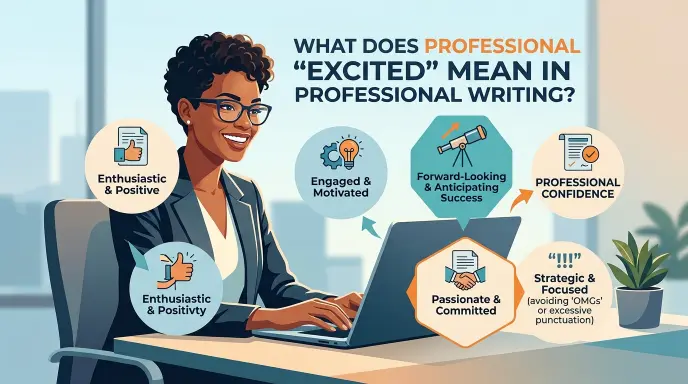
In professional communication, excited usually expresses strong enthusiasm or positive anticipation about something that is happening or may happen.
For example:
“I’m excited to join the team.”
This tells the reader that you feel strongly positive about joining.
However, “excited” can describe several slightly different ideas:
- Enthusiasm: “I’m enthusiastic about the opportunity.”
- Anticipation: “I’m looking forward to the meeting.”
- Motivation: “I’m motivated to contribute to the project.”
- Interest: “I’m very interested in the position.”
- Pleasure: “I’m delighted to accept the offer.”
- Eagerness: “I’m eager to begin.”
Understanding that difference helps you choose a more precise word.
Formal Alternatives to “Excited”
1. Enthusiastic
Meaning: Showing strong interest, energy, or positive feelings about something.
Explanation: Enthusiastic is one of the safest professional alternatives to excited. It communicates genuine interest without sounding overly emotional.
Example:
“I’m enthusiastic about the opportunity to contribute to the marketing team.”
Best Use: Cover letters, interviews, business emails, LinkedIn profiles, and professional introductions.
Worst Use: Highly formal documents where emotions are not relevant.
Tone: Professional, positive, confident.
2. Eager
Meaning: Very interested and ready to do something.
Explanation: Eager focuses more on readiness and willingness than emotional excitement.
Example:
“I’m eager to apply my experience to this new role.”
Best Use: Job applications, workplace communication, project updates, and professional introductions.
Worst Use: Situations where you want to emphasize celebration rather than readiness.
Tone: Professional and energetic.
3. Keen
Meaning: Very interested, willing, or enthusiastic.
Explanation: Keen is common in professional English, particularly in British English. It can sound polished but may feel less natural in some American business contexts.
Example:
“I’m keen to discuss how we can move the project forward.”
Best Use: Professional communication, meetings, international workplaces.
Worst Use: Highly formal American business writing if a more universally familiar word is preferable.
Tone: Professional and confident.
4. Delighted
Meaning: Very pleased or happy.
Explanation: Delighted works especially well when announcing positive news, accepting an offer, or responding to an invitation.
Example:
“I’m delighted to accept the position.”
Best Use: Offer acceptance, announcements, client communication, and formal correspondence.
Worst Use: Routine tasks where such strong enthusiasm may sound exaggerated.
Tone: Warm and formal.
5. Pleased
Meaning: Happy or satisfied about something.
Explanation: Pleased is more restrained than excited. It is useful when you want professionalism without strong emotional language.
Example:
“We’re pleased to announce the launch of our new service.”
Best Use: Corporate announcements, business emails, client communication, and formal writing.
Worst Use: Situations where you want to convey intense enthusiasm.
Tone: Polished, calm, professional.
6. Looking Forward To
Meaning: Feeling positive anticipation about a future event.
Explanation: This phrase is not a direct synonym for excited, but it is one of the most natural professional alternatives.
Example:
“I’m looking forward to meeting with you next week.”
Best Use: Emails, meetings, interviews, networking, and follow-ups.
Worst Use: Describing excitement about something that has already happened.
Tone: Professional and friendly.
7. Highly Interested
Meaning: Having a strong level of interest in something.
Explanation: This phrase removes much of the emotional tone associated with excited and emphasizes serious interest.
Example:
“I’m highly interested in the research opportunity.”
Best Use: Academic applications, job applications, business proposals.
Worst Use: Informal conversations where it may sound stiff.
Tone: Formal and measured.
8. Motivated
Meaning: Ready and willing to make an effort toward a goal.
Explanation: Motivated is not an exact synonym for excited. It focuses on action and determination rather than emotion.
Example:
“I’m motivated to help the team achieve its goals.”
Best Use: Resumes, interviews, performance reviews, applications.
Worst Use: Celebratory announcements where emotional enthusiasm is the main point.
Tone: Professional and goal-oriented.
9. Optimistic
Meaning: Expecting a positive result.
Explanation: Optimistic describes confidence about the future rather than excitement itself.
Example:
“We’re optimistic about the project’s next phase.”
Best Use: Business reports, leadership communication, project updates.
Worst Use: When you simply want to say you are happy about an opportunity.
Tone: Positive and measured.
10. Encouraged
Meaning: More confident or hopeful because of something positive.
Explanation: Encouraged works when new information has increased your confidence.
Example:
“We’re encouraged by the early results.”
Best Use: Business updates, research, project reports, and professional discussions.
Worst Use: Job applications when you simply want to express enthusiasm.
Tone: Formal and analytical.
Semi-Formal and Neutral Alternatives
11. Interested
Meaning: Wanting to know more about or participate in something.
Explanation: Interested is less emotional than excited. It is useful when you want to sound calm and professional.
Example:
“I’m interested in learning more about the position.”
Best Use: Initial inquiries and professional emails.
Worst Use: When you want to communicate strong enthusiasm.
Tone: Neutral.
12. Happy to
Meaning: Willing or pleased to do something.
Explanation: “Happy to” is common in workplace communication and sounds friendly without being overly emotional.
Example:
“I’m happy to provide additional information.”
Best Use: Emails, customer service, internal communication.
Worst Use: Highly formal academic writing.
Tone: Friendly and professional.
13. Glad to
Meaning: Pleased about something.
Explanation: Similar to “happy to,” but slightly more conversational.
Example:
“I’m glad to hear that the proposal was approved.”
Best Use: Workplace conversations and friendly professional emails.
Worst Use: Formal reports.
Tone: Warm and conversational.
14. Positive About
Meaning: Having a favorable view of something.
Explanation: This phrase works well when discussing an idea, plan, or future outcome.
Example:
“The leadership team is positive about the proposed changes.”
Best Use: Meetings, reports, workplace discussions.
Worst Use: Personal applications where stronger enthusiasm may be useful.
Tone: Neutral and professional.
15. Energized
Meaning: Filled with energy and motivation.
Explanation: Energized emphasizes renewed energy rather than simple happiness.
Example:
“After the workshop, I felt energized and ready to tackle the next phase.”
Best Use: Team communication, leadership writing, personal professional statements.
Worst Use: Highly formal reports.
Tone: Energetic and modern.
16. Inspired
Meaning: Motivated by an idea, person, experience, or achievement.
Explanation: Inspired is useful when something has created a strong desire to act or create.
Example:
“I was inspired by the team’s approach to solving the problem.”
Best Use: Personal statements, professional reflections, creative industries.
Worst Use: Routine administrative emails.
Tone: Positive and personal.
17. Ready
Meaning: Prepared and willing to begin.
Explanation: Ready doesn’t mean excited, but it can replace it when your real meaning is enthusiasm combined with preparedness.
Example:
“We’re ready to begin the next stage of the project.”
Best Use: Project communication and workplace updates.
Worst Use: When emotional enthusiasm is important.
Tone: Direct and confident.
18. Positive About the Opportunity
Meaning: Having a favorable opinion of a potential opportunity.
Explanation: This is a restrained alternative for situations where “excited” might sound too informal.
Example:
“I’m very positive about the opportunity to work with your organization.”
Best Use: Interviews, business communication, professional introductions.
Worst Use: Casual messages.
Tone: Polished and measured.
Informal and Casual Alternatives

Professional writing does not require every expression to sound stiff. Some alternatives can work in friendly workplace communication.
19. Thrilled
Meaning: Extremely excited or happy.
Example:
“I’m thrilled to be joining the team.”
When it sounds natural: Job announcements, LinkedIn posts, celebratory emails.
When to avoid it: Serious reports or sensitive business communication.
Tone: Warm and highly enthusiastic.
20. Really Looking Forward To
Meaning: Strongly anticipating something positive.
Example:
“I’m really looking forward to working with everyone.”
When it sounds natural: Team emails, messages, networking, and casual professional communication.
When to avoid it: Formal reports.
Tone: Friendly and enthusiastic.
21. Fired Up
Meaning: Extremely energized or motivated.
Example:
“The team is fired up about the upcoming competition.”
When it sounds natural: Casual workplace conversations, sports, creative teams.
When to avoid it: Formal emails, academic writing, and client correspondence.
Tone: Very casual and energetic.
22. Pumped
Meaning: Very excited or enthusiastic.
Example:
“I’m pumped to see what the team accomplishes this quarter.”
When it sounds natural: Informal messages and conversations.
When to avoid it: Resumes, cover letters, formal emails, and client communication.
Tone: Casual.
23. Can’t Wait
Meaning: Very eager for something to happen.
Example:
“I can’t wait to get started.”
When it sounds natural: Friendly workplace communication and social posts.
When to avoid it: Highly formal communication.
Tone: Casual and enthusiastic.
True Synonyms vs. Contextual Alternatives
| Type | What It Means | Can It Replace “Excited”? |
|---|---|---|
| True synonym | Similar emotional meaning of strong enthusiasm | Usually |
| Near synonym | Shares part of the meaning but emphasizes something else | Sometimes |
| Contextual alternative | Works naturally in a particular professional situation | Yes, in that context |
| Broader expression | Covers interest, happiness, motivation, or anticipation | Sometimes |
| Narrower expression | Focuses on one specific type of positive feeling | Only in suitable contexts |
For example, enthusiastic is a close synonym, while motivated is a contextual alternative. Someone can be motivated without being excited. Likewise, looking forward to expresses anticipation rather than excitement itself.
Industry-Specific Usage
Business Writing
Business writing generally benefits from calm, confident alternatives.
Good choices include:
- Enthusiastic
- Eager
- Looking forward to
- Pleased
- Optimistic
- Motivated
Example:
“We’re enthusiastic about the potential of this partnership.”
This sounds more polished than:
“We’re excited about this partnership.”
The original sentence is not wrong. The alternative simply provides a slightly more formal tone.
Corporate Communication
For announcements, internal updates, and reports, pleased, optimistic, encouraged, and enthusiastic often work well.
Example:
“We’re pleased to announce that the new platform is now available.”
For an internal team message:
“The team is enthusiastic about the next phase of the project.”
Academic Writing
Academic writing usually avoids strong emotional language unless the writer is describing motivation or personal interest.
Instead of:
“I’m excited to conduct this research.”
Consider:
“I’m eager to conduct this research.”
Or:
“I’m particularly interested in exploring this topic.”
For a personal statement, eager and enthusiastic can work well.
Customer Service
Customer-facing communication should sound positive without becoming overly emotional.
Instead of:
“We’re excited to help you!”
You might write:
“We’re happy to help.”
Or:
“We’re pleased to assist you.”
The best choice depends on the brand’s voice.
Legal Writing
Legal documents usually require neutral, factual language. Emotional alternatives to excited are rarely necessary.
Instead of:
“The parties are excited about the agreement.”
A formal document might simply state:
“The parties intend to proceed with the agreement.”
The correct wording depends on the document and legal context. Emotional synonyms should not be substituted into legal language merely for variety.
Email Communication
For professional emails, these phrases are especially useful:
- “I’m looking forward to…”
- “I’m eager to…”
- “I’m pleased to…”
- “I’m delighted to…”
- “I’m enthusiastic about…”
- “I’m happy to…”
They allow you to show enthusiasm while keeping the message professional.
Email Examples
1. Client Communication
Looking Forward to Our Discussion
Looking Forward to Our Discussion
Hi Daniel,
Thank you for sharing the project details. I’m looking forward to discussing the next steps with you on Thursday.
I’ve reviewed the proposal and noted a few points I’d like to explore during the call.
Best,
Arooj
2. Job Offer Acceptance
Accepting the Position
Accepting the Position
Dear Ms. Carter,
Thank you for the offer. I’m delighted to accept the position of Marketing Coordinator.
I appreciate the opportunity and look forward to joining the team on October 5.
Kind regards,
Arooj
3. Project Update
Next Phase of the Project
Next Phase of the Project
Hi Mark,
The initial testing results are encouraging, and I’m eager to move into the next phase.
I’ve attached the updated timeline for your review. Please let me know if you have any concerns before we proceed.
Best,
Arooj
4. Meeting Request
Meeting Next Week
Hi Laura,
I’m keen to discuss the new proposal and hear your thoughts on the implementation plan.
Would Tuesday afternoon work for a 30-minute meeting?
Thanks,
Arooj
5. Academic Communication
Research Project Discussion
Research Project Discussion
Dear Professor Adams,
I’m very interested in exploring the relationship between digital communication and language learning for my research project.
I’d appreciate the opportunity to discuss whether the proposed topic would be suitable for the assignment.
Best regards,
Arooj
6. Internal Workplace Email
Team Workshop
Team Workshop
Hi everyone,
I’m really looking forward to the workshop next week. I think the session will give us a useful opportunity to discuss the new workflow and share ideas.
Please review the agenda before Friday.
Thanks,
Arooj
Short Dialogue Examples
Workplace
Person A: How do you feel about leading the new project?
Person B: I’m enthusiastic about it. It’s a good opportunity to develop my skills.
Classroom
Person A: Are you interested in the research assignment?
Person B: Definitely. I’m eager to explore the topic.
Customer Service
Person A: Can you help me update my account?
Person B: Of course. I’m happy to help.
Casual Conversation
Person A: Are you going to the conference?
Person B: Yes! I can’t wait.
Professional Discussion
Person A: What do you think about the new strategy?
Person B: I’m optimistic about it, although we should review the budget first.
How to Replace “Excited” in a Sentence
Example 1
Original:
“I’m excited about the opportunity.”
Alternative:
“I’m enthusiastic about the opportunity.”
Why it works:
Enthusiastic preserves the positive feeling while sounding more professional.
Example 2
Original:
“I’m excited to join your team.”
Alternative:
“I’m eager to join your team.”
Why it works:
Eager emphasizes readiness and willingness.
Example 3
Original:
“I’m excited to meet you.”
Alternative:
“I’m looking forward to meeting you.”
Why it works:
This is a very natural professional email phrase.
Example 4
Original:
“We’re excited to announce the results.”
Alternative:
“We’re pleased to announce the results.”
Why it works:
Pleased sounds polished and works especially well for formal announcements.
Example 5
Original:
“I’m excited about the new position.”
Alternative:
“I’m delighted about the new position.”
Why it works:
Delighted communicates strong happiness and works well in formal correspondence.
Example 6
Original:
“I’m excited to start the project.”
Alternative:
“I’m eager to begin the project.”
Why it works:
Eager focuses on readiness to take action.
Example 7
Original:
“I’m excited about the results.”
Alternative:
“I’m optimistic about the results.”
Why it works:
Optimistic emphasizes confidence about the future rather than emotional excitement.
Example 8
Original:
“I’m excited to contribute to the team.”
Alternative:
“I’m motivated to contribute to the team.”
Why it works:
Motivated highlights the desire to take action and produce results.
Comparison Table
| Phrase | Tone | Meaning / Scope | Best Use | Example |
|---|---|---|---|---|
| Excited | Neutral/positive | Strong positive anticipation | General professional writing | Excited to join |
| Enthusiastic | Professional | Strong interest and energy | Applications, work | Enthusiastic about the role |
| Eager | Professional | Ready and willing | Applications, projects | Eager to contribute |
| Keen | Professional | Strong interest | Workplace communication | Keen to discuss |
| Delighted | Formal/warm | Very pleased | Announcements, offers | Delighted to accept |
| Pleased | Formal | Satisfied or happy | Corporate writing | Pleased to announce |
| Motivated | Professional | Driven to act | Resumes, interviews | Motivated to succeed |
| Optimistic | Formal | Positive about the future | Reports, business | Optimistic about growth |
| Interested | Neutral | Strong curiosity or attention | Inquiries | Interested in the role |
| Looking forward to | Professional | Positive anticipation | Emails, meetings | Looking forward to meeting |
| Thrilled | Warm | Extremely happy | Announcements | Thrilled to join |
| Happy to | Friendly | Willing or pleased | Emails | Happy to help |
| Inspired | Personal/professional | Motivated by something | Reflections | Inspired by the work |
Which Alternative Should You Choose?
For formal writing
Choose pleased, delighted, enthusiastic, eager, or optimistic.
For business communication
Enthusiastic, pleased, and looking forward to are reliable choices.
For academic writing
Use eager, interested, motivated, or enthusiastic when discussing genuine academic interest.
For legal writing
Avoid emotional wording unless the context specifically calls for it. Use factual language instead.
For professional emails
Looking forward to, eager to, pleased to, and happy to are natural choices.
For everyday conversation
Excited, really looking forward to, thrilled, and can’t wait sound natural.
For casual messages
Use pumped, fired up, or can’t wait only when the relationship and setting are informal.
Grammar & Usage Guide
“Excited about” + noun
Use excited about when the object is a person, thing, idea, event, or situation.
“I’m excited about the new project.”
“She’s excited about the opportunity.”
“Excited to” + verb
Use excited to before an infinitive.
“I’m excited to join the team.”
“We’re excited to announce the results.”
“Excited for” + event or person
“Excited for” is common in conversational American English.
“I’m excited for the conference.”
“We’re excited for the next phase.”
In formal writing, looking forward to may sound more polished.
“Excited about” vs. “excited to”
Use about before a noun phrase:
“I’m excited about the opportunity.”
Use to before a verb:
“I’m excited to accept the opportunity.”
Capitalization
The word excited and its synonyms are normally lowercase unless they begin a sentence or appear in a title.
“I’m enthusiastic about the role.”
Not:
“I’m Enthusiastic About the Role.”
Common word combinations
Natural professional combinations include:
- enthusiastic about the opportunity
- eager to contribute
- eager to learn
- pleased to announce
- delighted to accept
- looking forward to meeting
- motivated to succeed
- optimistic about the future
- interested in the position
- keen to discuss
These combinations often sound more natural than forcing a synonym into an unusual grammatical structure.
Common Mistakes to Avoid
1. Treating every synonym as identical
Excited, motivated, optimistic, and interested describe different states. Pick the word that matches your actual meaning.
2. Overusing “thrilled”
“Thrilled” is strong. Repeating it in every professional message can make your writing sound exaggerated.
3. Using slang professionally
Words such as pumped and fired up may work with close colleagues but can sound inappropriate in formal communication.
4. Choosing “motivated” when you mean happy
Motivation is about willingness to act. It does not necessarily express happiness or anticipation.
5. Using “keen” without considering the audience
Keen is natural professional English, but it may be less familiar or natural to some American readers.
6. Confusing “looking forward to” with “excited to”
“Looking forward to” expresses anticipation. It is not a perfect grammatical replacement in every sentence.
7. Making every email overly enthusiastic
Professional communication usually benefits from sincerity. Strong emotional language should fit the situation.
8. Repeating the same synonym
Replacing excited with enthusiastic everywhere does not improve your writing. Vary the wording according to meaning.
9. Using “excited for” in highly formal writing
Although common in conversation, “looking forward to” may be a cleaner choice for formal correspondence.
10. Forgetting the audience
A phrase that works on LinkedIn may not work in a legal document. Match the vocabulary to the reader.
When Not to Use “Excited”
There are situations where another expression will communicate your meaning more precisely.
1. When you mean “ready”
Use prepared or ready.
“We are ready to begin.”
2. When you mean “motivated”
Use motivated.
“I’m motivated to improve the process.”
3. When you mean “confident about the future”
Use optimistic.
“We’re optimistic about the outcome.”
4. When you mean “pleased”
Use pleased or delighted.
“We’re pleased to announce the decision.”
5. When you mean “interested”
Use interested.
“I’m interested in learning more about the position.”
6. When the document requires neutral language
In legal, technical, or highly analytical writing, emotional language may be unnecessary.
7. When “excited” has become repetitive
If you have used the word several times, restructure the sentence rather than replacing it mechanically.
8. When a simpler phrase is clearer
Sometimes:
“I look forward to working with you.”
is better than:
“I am extremely enthusiastic and excited about the opportunity to work with you.”
Advanced Writer Tips
Tone Control
You can adjust the strength of your message easily.
Reserved:
“I’m interested in the opportunity.”
Professional:
“I’m enthusiastic about the opportunity.”
Strong:
“I’m eager to contribute to the team.”
Very enthusiastic:
“I’m thrilled to be joining the organization.”
Use the strongest version only when the situation supports it.
Professional Email Etiquette
A professional email doesn’t need to sound emotionless. The goal is controlled enthusiasm.
Instead of:
“I’m SO excited to finally work with you!!!”
Try:
“I’m looking forward to working with you.”
The second version is warm without appearing excessive.
Politeness
Some alternatives soften your message.
Compare:
“I’m excited to get your feedback.”
with:
“I’m looking forward to hearing your thoughts.”
The second version can feel less demanding and more collaborative.
Context Alignment
Consider what you are trying to express:
Feeling: excited, thrilled, delighted
Interest: interested, keen, enthusiastic
Readiness: eager, ready, prepared
Drive: motivated, energized
Anticipation: looking forward to
Confidence: optimistic, encouraged
This simple distinction can make professional writing much more precise.
Precision
Don’t choose a synonym because it sounds more sophisticated.
If you’re accepting a job offer, delighted to accept may be perfect.
you’re preparing for a project, eager to begin may be better.
If you’re discussing expected results, optimistic about may communicate your meaning more accurately.
Readability
Keep professional enthusiasm simple.
Instead of:
“I would like to express my profound enthusiasm regarding the prospective opportunity.”
Write:
“I’m enthusiastic about the opportunity.”
Clear writing almost always sounds more confident.
Related Questions
What is another professional way to say “excited”?
Enthusiastic, eager, pleased, delighted, motivated, keen, and looking forward to are strong professional options. The best choice depends on whether you mean enthusiasm, anticipation, happiness, or motivation.
What is a formal alternative to “excited”?
Enthusiastic, delighted, pleased, eager, and optimistic can all work in formal settings. Pleased and delighted are particularly useful for formal announcements.
What is a professional way to say “I’m excited”?
Try:
“I’m enthusiastic about the opportunity.”
or:
“I’m looking forward to the opportunity.”
For a more action-focused statement:
“I’m eager to contribute.”
What can I use instead of “excited to join the team”?
You could write:
“I’m eager to join the team.”
“I’m delighted to join the team.”
“I’m looking forward to joining the team.”
Each has a slightly different tone.
Is “excited” professional?
Yes. Excited is not inherently unprofessional. It is widely used in workplace communication. However, alternatives such as enthusiastic, pleased, or looking forward to may sound more polished in certain formal situations.
Is “thrilled” too informal for work?
Not necessarily. Thrilled can work well in celebratory professional announcements, job acceptance messages, and LinkedIn posts. It may be too emotional for formal reports or highly restrained communication.
Is “eager” better than “excited”?
Neither is universally better. Eager emphasizes readiness and willingness, while excited emphasizes strong positive emotion and anticipation. Choose based on your intended meaning.
FAQs
1. What is the best professional synonym for “excited”?
Enthusiastic is one of the safest choices. It communicates strong positive interest while maintaining a professional tone. Eager is better when you want to emphasize readiness to act.
2. How do I say “excited” professionally in an email?
Use phrases such as “I’m looking forward to,” “I’m eager to,” “I’m pleased to,” or “I’m enthusiastic about.” For most professional emails, “looking forward to” is especially natural.
3. What is a formal way to say “I’m excited to work with you”?
A polished option is:
“I’m looking forward to working with you.”
For stronger enthusiasm:
“I’m delighted to have the opportunity to work with you.”
4. Can I use “thrilled” in a professional email?
Yes, if the situation is genuinely positive and celebratory. “Thrilled” is stronger than “excited,” so it should not be used for routine matters.
5. What is the difference between “excited” and “enthusiastic”?
Excited often describes a strong emotional reaction or anticipation. Enthusiastic focuses more on sustained interest, energy, and support for something.
6. What is the difference between “eager” and “excited”?
Eager emphasizes willingness and readiness. Excited emphasizes positive emotion and anticipation. Someone can be eager without feeling highly excited.
7. What is the best alternative for a resume?
For resumes, motivated, enthusiastic, interested, and driven are usually more useful than excited. A resume should focus on skills, actions, and results rather than emotional reactions.
Key Takeaways
- Enthusiastic is one of the safest professional alternatives to “excited.”
- Use eager when you want to show readiness and willingness to act.
- Choose looking forward to for natural, polished professional emails.
- Use pleased or delighted for positive announcements and formal responses.
- Don’t treat motivated, interested, optimistic, and excited as exact synonyms; each emphasizes something different.
Conclusion
The best professional alternative to excited depends on the message you want to send. If you want to show genuine enthusiasm, enthusiastic is a reliable choice. If you want to show readiness, eager works better. For professional emails, looking forward to is natural, warm, and polished. Pleased and delighted are useful for announcements, offers, and positive business communication, while motivated is stronger when your focus is action and achievement.
You don’t need to remove the word excited from professional writing altogether. It is a perfectly acceptable word when the context supports it. The real goal is precision. Choose a phrase that reflects the right level of enthusiasm and matches your audience. A job application, client email, team message, academic statement, and casual workplace chat may all require different wording. Good professional writing sounds sincere, not artificially formal.
